Each month, the 'Day in the Life' series offers PACFA members the opportunity to share their personal and professional experience as dedicated Practising & Registered Clinical Counsellors and Registered Clinical Psychotherapists who embody the art and science of holding space for others.
This month, we follow the day with PACFA Registered Clinical Counsellor, Germaine Leece.
About Germaine
I am a PACFA Registered Clinical Counsellor and currently working towards becoming a PACFA Registered Clinical Psychotherapist as I am training to become a psychoanalyst with the Australian Psychoanalytical Society. I have a private practice in Crows Nest, Sydney. Before this, I worked as a Specialist Counsellor in General Mental Health and Domestic Family Violence for an NGO and practised as the Resident Bibliotherapist at Alain de Botton’s School of Life, Sydney. Bibliotherapy was a marriage of two careers – before becoming a counsellor, I worked in book editing and I was a writer. Using literature as a way of exploring the human condition and understanding the self in a therapeutic context made sense of my long (and continuing journey) towards becoming a psychoanalyst. Not that I consciously realised this at the time!
In 2021, I co-wrote a book with fellow bibliotherapist and social worker, Sonya Tsakalakis titled Reading the Seasons: Books Holding Life and Friendship Together. Since 2022, I have co-presented a podcast called Something to Eat and Something to Read with food writer and cookbook author Sophie Hansen. In each episode we talk about the shape a particular book left on us and how reading and cooking nourish our emotional worlds and our relationships.
My experience of working with women who had complex childhood trauma led me towards a psychodynamic way of working early on in my career. Seeing my clients grow and their lives change, while also recognising there was more work to do took me to more psychoanalytic-oriented professional development training and eventually towards the realisation that psychoanalysis was the lens through which I wanted to view and understand the world.
The training has been life-changing both personally and professionally and my practice has moved towards helping people navigate and integrate life transitions; those we expect and those we don’t. I see people weekly or at a higher frequency, depending on the how intensely they want to work. Providing space for people to develop their curiosity, find out more about their inner worlds, begin to see the patterns created in their pasts and learn more about themselves through the therapeutic relationship can lead to transformative changes which is always humbling and rewarding to witness.
A Day in the Life with Germaine
6.45am: Reluctantly wake-up
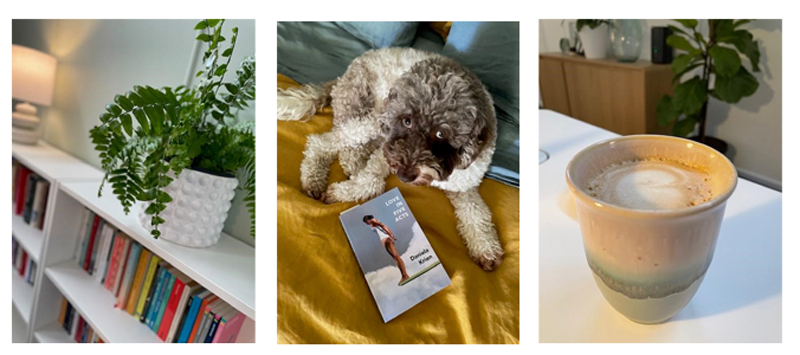
I’m not a great early morning person and now that my children are well into their teens, it has been a while since they have woken me! Our 5-year-old groodle named Dottie enjoys sleeping-in even more than me so she is also not a good alarm clock. The promise of a pot of tea brewed by my husband helps and I read the newspaper and check my emails while I eat breakfast.
7.30am – 8.30am: Pilates class
I’m only managing to get to this class once a week, but it makes a great difference to my posture and stretches me out before another day of sitting. I am regularly reminded by older therapists about the importance of choosing your chair wisely lest you succumb to the occupational hazard of back issues. At a recent conference a group of colleagues and I spent the morning tea break comparing chairs and different ways of arranging cushions to avoid aching backs!
9am – 10am: Recording an episode of Something to Eat and Something to Read
I arrive at my consulting room in Crows Nest with a latte from the café across the road and turn on the lamps, straighten the cushions and set up my laptop.
Once a month I record a podcast episode with Sophie. The book we have both read this month is Butter by Asako Yuzuki. I think it’s a great exploration of psychic deadness and aliveness and this is how we frame our discussion. Throughout the story, the main character Rika and all the people in her life have an awakening. By the end of the book, there is hope that they can live their lives more fully, becoming more “alive” in their experience of the world. Much of this is shown through food and the way each character must find their own appetite both literal and metaphorical.
After the recording we chat about the book for next month: The Secret of Cooking by Bee Wilson. It’s a book that thinks about cooking differently, such as using time as an ingredient, treating cooking as a remedy, cutting yourself some slack and cooking for the life you have. I can see it will also be another good conversation about the ways books and cooking can be helpful for our emotional wellbeing.
10.30am – 1.30pm: In sessions
Sessions with clients are scheduled for the same time and day each week. If people come more than once a week, I also like to offer the same time on their other days. This builds a frame around the space belonging to them, as well as adding a rhythm to their work and helping create a relationship they can rely on. I prefer working face-to-face and clients have the option of sitting in an armchair or lying on the couch, but I also work on zoom with people who live outside of Sydney.
Sessions are not goal-oriented or about treatment plans. Instead, they are about opening people up to allow something to unfold, make associations with and connect feeling with understanding. When I first started training, my supervisor told me that I was “stitching people up too quickly, as though they were bleeding everywhere”. This came from my experience of working with trauma and focusing on stabilisation; yet in my private practice, my clients weren’t “bleeding” and were looking for a space to be contained while they opened up parts of their minds they hadn’t explored as well as learning to tolerate uncomfortable feelings, sit with pain and bear distress. That image has helped me enormously in the years since; it’s a different way to think about holding and containment.
My sessions last 50 minutes and in the 10 minutes between sessions, I write up my notes, have a quick stretch and read over the previous session notes of the next client.
2pm - 2.50pm: My own analysis session
After eating sushi and drinking some water, I walk to my own analysis session which is 15 minutes away.
A core part of the psychoanalytic training is to be in your own four-day-a-week analysis with a Training Analyst. Since qualifying as a counsellor, I saw a psychotherapist weekly as I believed it was an ethical responsibility to know myself and be able to separate what was mine from what was my clients. I understood my therapist’s belief that you can only take people as far as you have gone yourself and I also saw it as necessary prevention from vicarious trauma and burnout. It was an enlightening and supportive experience and made me curious to delve deeper. Therefore, when thinking about embarking on the psychoanalytic training it made complete sense that personal analysis was an essential part of the training as I wouldn’t be able to understand someone else’s unconscious until I had experience of gaining a deep understanding of my own unconscious mental life.
When I first met my analyst, she told me that I would both love and hate my analysis and her words often echo in my mind! It has been everything: challenging, confronting, painful, frustrating, hopeful, exciting, reassuring, purposeful and healing. It has helped enormously with my own practice and in my personal life. There is nothing like being a patient to get a true, explicit understanding of transference and countertransference.
3.30pm – 5.30pm: Back to sessions
I generally see four or five clients a day. The walk back from analysis offers space to process my personal work before getting back into my practice. There is time for tea and a chocolate digestive before I open my door for the next session.
6pm: Home and unwind
Now that our family has two university students with part-time jobs and a highschooler with a part-time job, the number at the table vary each night. This year has been a huge transition for me in terms of our family life. I have always loved having us all around the table at night, the certainty of coming together in the evening helped me feel connected to everyone. This is now changing and new ways of connecting are being thought about.
After dinner, my husband and I and Dottie the dog will watch a tv series together. Tonight, we enjoy an episode of Colin from Accounts. I try to get to bed by 10pm and I always read before going to sleep, no matter how late it is. I often wake up with my glasses on holding my book but it is the time of day I most look forward to!
I have always read before going to sleep and as much as I enjoy reading psychotherapy books (especially case studies, such as Maybe You Should Talk To Someone by Lori Gottleib, The Examined Life by Stephen Grosz, Tell me the Truth About Love by Susanna Abse, The Well-Gardened Mind by Sue Stuart Smith or Emotional Inheritance by Galit Atlas) I find so much nourishment in fiction. I tend to switch between genres depending on what’s going on in my life. I read short stories when I have a lot of study also going on and recently loved Games & Rituals by Katherine Heiny, Table for Two by Amor Towles and After the Funeral by Tessa Hadley.
I love novels that explore the interior of characters’ minds and recent ones that have stayed with me include The In Between by Christos Tsiolkas, Caledonian Road by Andrew O’Hagan, All Fours by Miranda July and Scaffolding by Lauren Elkin.
When I need a break from the minds of others and my own, I reach for stories that I know will end happily: My Favourite Mistake by Marian Keyes and You Are Here by David Nicholls are most recent. Alexander McCall Smith’s Isabel Dalhousie series is a definite comfort read if I am feeling fragile. And at times when I am very stressed and anxious, I find psychological or crime fiction helps enormously! Nicci French and Lisa Jewell reliably fulfil this need and I recently enjoyed Lucy Atkins’s The Night Visitor.
It’s just after 11pm and I reluctantly put down my current novel, Pelican Girls by Julia Malye. I don’t often read historical fiction but I am enjoying this story set in 1720 about 38 women of child-bearing age who are sent from a hospital for “difficult” women in Paris to New Orleans to be married off to French settlers who are looking for wives. Based on a true story, it’s one of friendship, resilience and identity. It’s a reminder of universal human experiences despite being set in a different era. I often think of a quote from CS Lewis about why he reads, “My own eyes are not enough for me, I will see through those of others.” I’m grateful for the writers who continue to give me different sets of eyes to gain greater understanding of the human condition both personally and professionally.
Connect with Germaine
- Website
- Instagram
- Podcast